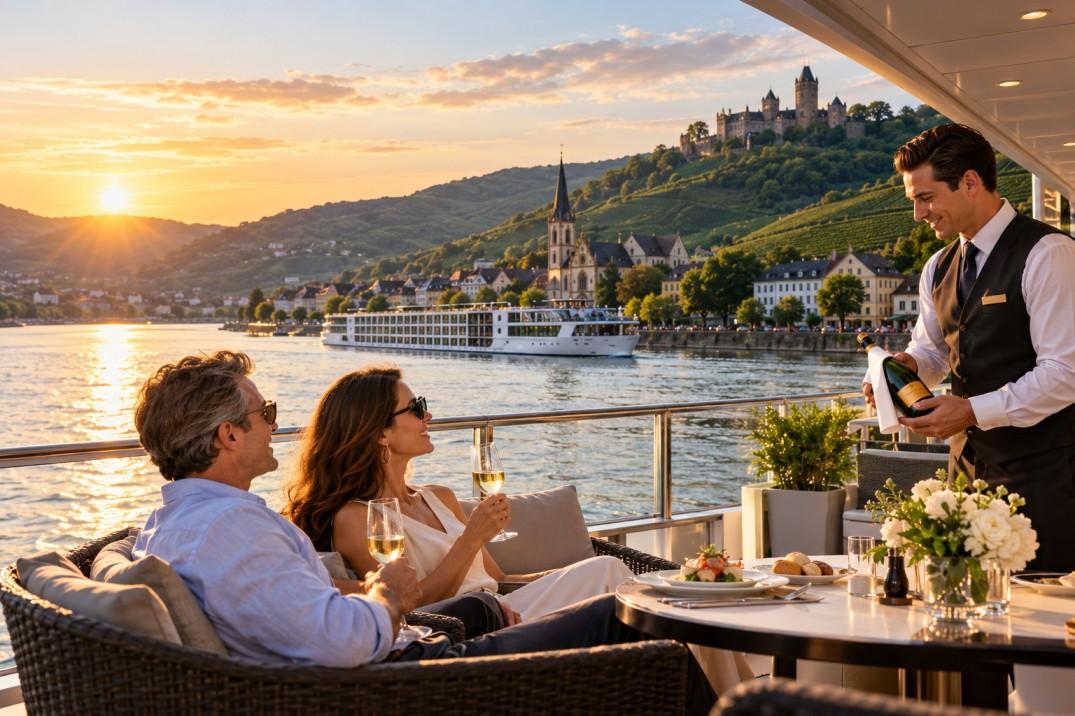
You see the per-diem price and you hesitate – luxury river cruises run $400 to $950+ per day, according to River Cruise Advisor, and that's a serious commitment. You're already accustomed to five-star hotels and premium travel experiences, so the sticker shock is real. But here's what changes everything: that headline number already includes your drinks, excursions, gratuities, and transfers – everything bundled together – whereas ocean cruises unbundle nearly every add-on and charge you separately for each one. The real question isn't whether river cruises are expensive; they are. The question is whether what you're getting for that money delivers more value, comfort, and genuine experience than the alternatives.
According to River Cruise Advisor, luxury river cruise per diems typically range $400–$950+ per day all-in for 2026 European itineraries, with ultra-luxury lines (Scenic, Tauck, Uniworld) often reaching $600–$900+.
Four concrete value signals justify the premium – and they're what separate river luxury from everything else you'd consider:
- All-inclusive pricing that eliminates surprise charges mid-cruise
- High space-to-guest ratios (as low as 1:2) that deliver genuine spaciousness
- Port access that puts you in the heart of destinations, not anchored miles offshore
- Itinerary depth that trades quantity of stops for meaningful immersion and regional expertise
Once you factor in what ocean cruises charge separately – drinks, excursions, gratuities – the gap between river and ocean pricing narrows considerably. That's where the real comparison lives, and where river cruising begins to look like the smarter investment.
Does the Upfront Price Tell the Whole Story?
You see a river cruise quote – let's say $5,000 per person for a week – next to an ocean cruise at $3,500, and your first instinct is to flinch. The number looks higher, and that feels like the end of the conversation. But here's what the math actually reveals: that ocean price is missing roughly $600–$1,050 per week in charges that'll show up later – drinks, excursions, gratuities – while river cruises bundle all of it upfront, and luxury all-inclusive ocean cruises themselves run $850–$1,400 per person per day, narrowing the gap to nearly nothing. When you total the genuine cost of each, river pricing almost always wins, delivering no hidden charges, no surprise post-trip invoices, and genuine peace of mind.
|
What Costs Extra |
Ocean Cruise |
River Cruise |
|
Alcoholic drinks |
$70–$100/day |
Included |
|
Shore excursions |
$50–$150 each |
Included |
|
Gratuities |
$18–$20/day |
Included |
|
Luxury all-inclusive ocean per day |
$850–$1,400 |
Typical river range |
According to Forest Travel, the ocean model charges you for nearly everything – a cocktail by the pool, an organized tour in port, even specialty dining – while a river cruise has already folded all of it into your fare. It's like comparing a bare-bones apartment rental (low monthly rent, but you pay utilities, buy furniture, arrange Wi-Fi) to a furnished lease where everything's covered upfront. The gap that looked so wide on the headline number collapses the moment you price what you'd actually spend.
According to Forest Travel, the ocean model charges you for nearly everything – a cocktail by the pool, an organized tour in port, even specialty dining – while a river cruise has already folded all of it into your fare. It's like comparing a bare-bones apartment rental (low monthly rent, but you pay utilities, buy furniture, arrange Wi-Fi) to a furnished lease where everything's covered upfront. The gap that looked so wide on the headline number collapses the moment you price what you'd actually spend.
Small Ship Travel reports that all-inclusive luxury ocean cruises themselves run $850–$1,400 per person per day. That's competitive with or higher than many river cruises – yet you're still paying à la carte for experiences that river lines include as standard. The honest total cost nearly always favors river, which brings you to the next crucial question: which river lines actually deliver on that all-inclusive promise – because not every operator defines it the same way.
What Does 'All-Inclusive' Actually Include on a Luxury River Cruise?
You've probably seen "all-inclusive" mean wildly different things - a free breakfast here, a welcome cocktail there - so it's fair to be skeptical when a river cruise line uses the same phrase. Not all lines define it the same way, and that gap matters. Three companies – Tauck, Scenic, and Uniworld – offer truly comprehensive packages covering drinks, excursions, gratuities, and transfers, while a second tier – AmaWaterways, Viking, and Avalon – bundles meals, beer and wine at meals, Wi-Fi, and at least one excursion per port but leaves premium beverages, optional tours, and gratuities outside. Per Quartz, Tauck maintains an exceptionally lean crew ratio of one staff member per two to three guests. The payoff? No surprise bills, no decision fatigue at the shore excursion desk, and no post-trip sting when the credit card statement arrives.
Here's what that distinction actually looks like:
-
Tier 1 (fully all-inclusive): Every drink – spirits, wine, cocktails – is covered. Every excursion is included; you simply choose which one appeals to you each day rather than debating cost. Gratuities and airport transfers are built in, so your final bill is genuinely final.
-
Tier 2 (meals and select beverages): Your accommodation and all meals are covered, along with beer and wine served at lunch and dinner. You get one excursion per port at no charge, but premium shore experiences – private museum tours, special dining – cost extra. Gratuities typically aren't included, though some lines are moving in that direction.
Butler service for every suite. A mini-bar restocked daily. Five distinct dining venues – some regionally inspired or wine-paired. Complimentary e-bikes to explore ports at your own pace. That's what Scenic's all-inclusive rate delivers.
That clarity takes the mental weight off your holiday entirely - no running tallies in your head, no awkward pause before ordering a second glass of wine. Whether those extras justify the premium depends on your travel style and how you like to move through a destination. But knowing exactly where the line falls lets you book with genuine confidence.
Why Do Ports Matter More Than Most Travelers Realize?
You've just locked in a luxury cruise - all-inclusive perks, butler service, the works - but here's what many travelers don't realize until they're standing on the dock: where the ship actually parks can shrink your vacation time by hours. Ocean ships dock 45–60 minutes away from city centers at remote industrial ports, forcing you onto shuttle buses before you even glimpse the destination. River ships, by contrast, moor you directly into the heart of Vienna, Porto, or Budapest - no tenders (those small ferries that ferry you from ship to shore), no transfers, just you and the city center waiting beyond the gangway. When you multiply that reclaimed time across 7–14 ports on a single itinerary, the advantage becomes profound: you're gaining back an entire day or more of actual exploration.
The ocean port problem cuts deep. Most mega-ships are simply too large to navigate into historic city centers - they're designed for commercial harbors on the outskirts. That means a commute before your vacation actually begins, and another one just to get back.
River ships dock where the real exploration happens. You walk off and you're already there - in the cobblestone streets, the markets, the museums. No waiting. No bus ride. Just immediate access to what you came for.
Then there's the tender logistics. Between waiting for the ferry, queuing to board, riding into town, and reversing the whole dance just to get back to the ship - you're looking at losing two to three hours per port on an ocean itinerary. River cruises eliminate that time drain entirely, which means more hours actually wandering, tasting, experiencing.
Multiply those hours across a week or two-week itinerary and you're not just gaining time - you're fundamentally changing the quality of how deeply you can know a place.
How Does Space-to-Guest Ratio Change the Experience?
You might not think much about the number of people on a ship-it's easy to assume 200 guests or 4,000 guests won't make that much difference. But the math here is unforgiving: luxury river vessels carry just 100–190 guests compared to ocean ships' 2,000–5,000, and that modest headcount fuels a crew-to-guest ratio (typically 1:2 to 1:3.3 depending on the line) that transforms how staff treat you – they learn your name, preferences, and dietary needs within 48 hours, anticipate your requests before you voice them, and deliver a level of personalization that simply can't happen on a floating city. The difference between Riverside's butler service – unpacking your luggage, pressing your clothes, arranging in-suite meals, booking your shore excursions – and standard ocean-cruise housekeeping illustrates what that ratio feels like in practice, right down to heated marble bathroom floors and Japanese Toto toilets (Japanese luxury bidets with integrated features like heated seats and air-drying). It's less like being one of thousands moving through a mega-resort and more like staying at a 20-room boutique inn rather than a 500-room hotel.
So what does a 1:2 crew-to-guest ratio actually feel like day-to-day?
By day two, your server remembers how you take your coffee. The sommelier recalls your wine preference. The concierge has already sorted your dietary requests with the kitchen. That's the kind of intimacy that doesn't happen by accident—it happens because there simply aren't 4,000 other guests competing for the same attention.
|
Line |
Crew-to-Guest Ratio |
Key Service Detail |
|
Riverside |
1:2 |
Butler service on all suites; unpacks luggage, arranges meals and excursions |
|
Tauck |
1:2–2.6 |
All drinks and excursions included; fully guided with Tauck Directors |
|
Uniworld |
1:2.4–3.2 |
Boutique-style ships with individually designed suites; butlers on premium cabins |
|
AmaWaterways |
1:2.8–3.3 |
Twin-balcony staterooms, wellness programs, gourmet dining included |
Each line calibrates service differently, but the common thread is this: you're never just a room number. That's what separates a luxury river cruise from a mainstream ocean voyage-and once you factor in what that personal service unlocks on shore, well, that's where the real depth of your itinerary kicks in. If you'd like help matching your preferences to the right river line and their crew-to-guest model, Travoluxury can walk you through those comparisons and build an itinerary around the service style that matters most to you.
Does Itinerary Depth Justify the Premium?
River cruises trade breadth for depth. You're anchoring in a single region or country where cultural context builds day by day instead of resetting with each port - and that shift changes everything about what you learn and retain. Guided excursions bundled into your fare (local markets, UNESCO sites, wine estates) aren't optional add-ons but core to the journey itself. Meanwhile, ocean cruises suit a different traveler entirely, one drawn to sea days and entertainment variety rather than cultural immersion. European rivers lead the pack, but the Mekong, Nile, and Zambezi deliver the same depth model.
Depth over breadth: Instead of hopping from Caribbean island to Caribbean island, you're settling into a place. The Rhine, Danube, or Douro unfold gradually - and that consistency builds real context that a quick port stop simply can't match. You dock right in the heart of historic cities like Budapest and Porto, stepping straight into the city center with no tenders or long transfers.
Excursions included, not itemized: Here's where river cruising cuts through the nickel-and-diming that ocean cruises normalize. Guided tours - wine tastings at family estates, walks through UNESCO World Heritage sites, access to local markets - arrive already woven into your fare. No calculator. No wondering if you should skip something because it costs too much.
Why ocean cruises feel different: They're built around entertainment, sea days, and variety of dining venues and shows. That's a genuinely different product. Not better. Not worse. Just designed for a traveler who wants openness, not immersion.
How to Decide If a Luxury River Cruise Fits Your Travel Goals
You're uncertain whether a river cruise justifies the premium or if you'd get better value staying put and taking day trips instead. A luxury river cruise delivers strongest value for culture-focused, port-intensive travelers who want predictable, all-in pricing without itemized add-ons. Ask yourself three questions - answer honestly. Do you prefer depth over breadth - staying in one region rather than island-hopping? Do you want walking-distance ports you can explore solo? Do you crave bundled costs with meals, excursions, and transfers included? All three yes means the premium is already justified. Compare that against land hopping - separate hotels, coordinated restaurants, booked excursions, baggage transfers. A river cruise absorbs all that friction. Travoluxury can match you with the right line and itinerary for your travel style. The real question isn't the price tag - it's whether you're a depth-first traveler at heart.